
How Is ICSI Different from IVF? Key Differences, Benefits & Which One to Choose

In the realm of fertility treatments, you may come across several procedures, all promising high success rates and benefits. While on your journey toward parenthood, it is essential to choose the treatment that best suits your needs. If you don’t know how ICSI and IVF differ, making the right choice can be difficult. So, how is ICSI different from IVF—and which one should you pick?
What Is IVF Treatment?
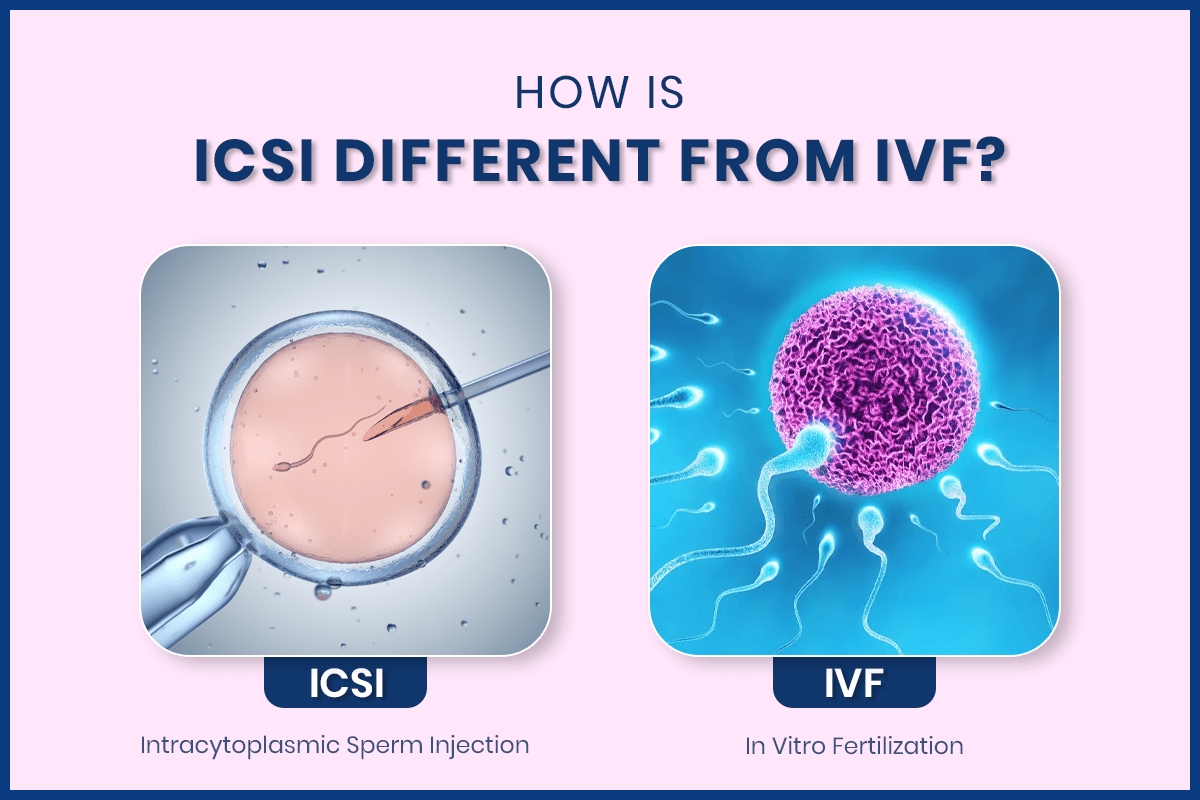
In vitro fertilisation (IVF) is an assisted reproductive technology that involves fertilising a woman’s eggs by placing them in a laboratory dish with sperm, allowing fertilisation to occur naturally. The healthiest embryo is then transferred to the patient’s uterus.
We recommend IVF for patients dealing with the following issues:
- Unexplained infertility
- Ovulation disorders
- Endometriosis
- Fallopian tube blockages
- Male factor infertility
- PCOS
- Premature ovarian failure
What Is ICSI Treatment?
Intracytoplasmic Sperm Injection (ICSI) is a specialised form of IVF in which a single live sperm is directly injected into the cytoplasm of a mature egg, instead of waiting for natural fertilisation. The rest of the process—from ovarian stimulation to embryo transfer—remains the same.
We recommend ICSI for severe male infertility, including:
- Low sperm count
- Abnormal sperm morphology
- Poor sperm motility
- Vasectomy reversal
- Previous failed fertilisation attempts with standard IVF
- Surgically retrieved sperm through TESA, PESA, or M-TESE
In certain cases of severe sperm abnormalities, your fertility specialist may recommend combining ICSI with a specialised sperm selection technique such as PICSI or IMSI.
What Are the Differences Between IVF and ICSI?
One of the key differences between IVF and ICSI lies in how fertilisation occurs. In IVF, many sperm and eggs are placed together in a dish, allowing fertilisation to happen naturally.
In ICSI, a single sperm is injected directly into the cytoplasm of a mature egg. This is repeated for each egg individually, significantly improving the chances of fertilisation, especially when sperm parameters are poor. Since it involves advanced micromanipulation, ICSI is more expensive than standard IVF.
While ICSI is particularly effective in treating male infertility, IVF can address a broader range of fertility concerns. Importantly, ICSI has not been shown to improve live birth rates in patients without male factor infertility.
What Are the Benefits of ICSI Over IVF?
ICSI is more costly than conventional IVF, but it offers several key advantages:
- Requires only a few viable sperm cells, whereas IVF needs a higher sperm count
- Higher fertilisation and success rates in male factor infertility
- Effective even with significantly abnormal sperm parameters
- Better outcomes when using frozen eggs or surgically retrieved sperm
Some IVF clinics in Mumbai now offer ICSI as a default option, but it may not always be necessary. ICSI typically has a fertilisation success rate of 50–80%, but overall clinical outcomes depend on several factors, including embryo quality and the woman’s age.
Which One Should You Choose?
| Criteria | IVF | ICSI |
|---|---|---|
| Process | Eggs and sperm are placed together outside the body for natural fertilisation. | A single sperm is directly injected into a mature egg to fertilise it. |
| Cost | ₹1,20,000 – ₹2,00,000 per cycle | ₹1,50,000 – ₹2,50,000 per cycle |
| Success Rates | 30%–50%, varies with age and infertility factors | Comparable to IVF; higher when male infertility is present |
| Ideal Candidates | Couples with male, female or unexplained infertility | Couples with severe male infertility or previous IVF fertilisation failure |
Both IVF and ICSI have their pros and cons, along with specific ideal use cases. While ICSI offers improved fertilisation rates, it does not guarantee an increase in blastocysts or euploid embryos. In fact, IVF may yield better outcomes than ICSI when the primary issue lies with female infertility.
As with all fertility treatments, your personal and medical history, the woman’s age, and the quality of the eggs and sperm play a significant role in the success of IVF or ICSI. At Bloom IVF, both procedures are performed by specialists with decades of experience. They are extremely safe and associated with a very low risk of complications.
We perform both ICSI and IVF using cutting-edge medical equipment and state-of-the-art infrastructure. Our team of fertility specialists offers each patient personalised care and world-class treatment at highly affordable rates.
Still confused between ICSI and IVF? Book a consultation at Bloom IVF today and get expert guidance along with high-quality treatment options tailored to your needs.
Frequently Asked Questions
What is PICSI?
PICSI (Physiological ICSI) is an advanced form of ICSI in which sperm are selected based on their ability to bind to hyaluronic acid — a compound naturally found around the egg. This helps choose the most mature and genetically competent sperm. Once selected, these sperm are injected into the eggs using the standard ICSI protocol.
Is ICSI a risky procedure?
No, ICSI is not considered a risky procedure. It carries the same level of risk as standard IVF and is generally safe, especially when performed at a reputed fertility clinic like Bloom IVF by experienced specialists.
Is paying extra for ICSI worth it?
Yes, paying extra for ICSI can be worth it — particularly if you’re facing issues like male factor infertility, low sperm count, poor motility, or previous IVF cycles with failed fertilisation. It can significantly improve fertilisation rates in such cases.
What is the difference between IVF and ICSI?
IVF allows fertilisation to happen naturally by placing many sperm near the egg in a lab dish. In contrast, ICSI is a specialised technique where a single healthy sperm is directly injected into an egg, improving fertilisation chances, especially when sperm quality is poor.
Which is more successful – IVF or ICSI?
Both IVF and ICSI offer high success rates, but the better option depends on the underlying cause of infertility. ICSI has higher fertilisation success in cases involving male factor infertility, while IVF may be more suitable in female-related or unexplained infertility.